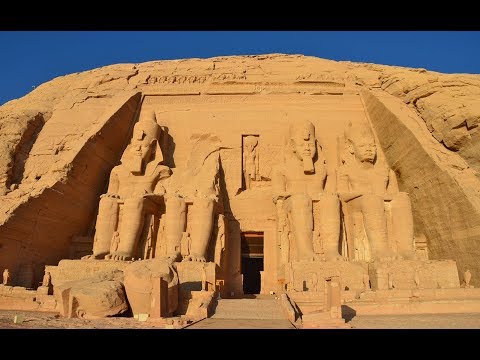
ABU SIMBEL (EGIPTO)
The history of the Abu Simbel temples begins with the twenty year effort to build these impressive structures, along with four other rock temples built in Nubia during the reign of Ramses II. The construction of Abu Simbel started around 1244 BC and was finished around 1224 BC.
Many scholars believe that the two temples of Abu Simbel were an act of ego, pride and love on the side of Ramses II. He ordered these temples built to:
Commemorate his victory at the Battle of Kadesh. To represent the battle, the base of the temple was carved with figures of bound captives.
Intimidate Egypt's neighbors, the Nubians. It was Ramses' way of trying to make an impression upon Egypt's neighbors, as well as to force Egypt's religion upon these neighbors.
Honor Nefertari: The Small Temple is a monument to his most beloved queen (out of his many wives), Nefertari. It is also dedicated to the ancient Egyptian goddess Hathor.
Honor himself: The Great Temple Ramses had built to honor himself, dedicating it to the god Re-Horakhty.


Colossi of Memnon, Luxor, Egypt
The Colossi of Memnon (Arabic: el-Colossat or es-Salamat) are two massive stone statues of the Pharaoh Amenhotep III, who reigned in Egypt during the Dynasty XVIII. Since 1350 BCE, they have stood in the Theban Necropolis, located west of the River Nile from the modern city of Luxor.
Dedicated to: Amenhotep III. Location: West of Luxor. Material: quartzite stone. Height: 18 m (60 ft)


Hatshepsut Temple
She built the temple Djeser-djeseru ("holiest of holy places"), which was dedicated to Amon and served as her funerary cult, and erected a pair of red granite obelisks at the Temple of Amon at Karnak, one of which still stands today.
-


Karnak Temple
Located at the northern end of the town of Luxor, Karnak Temple has three main sacred areas that honour three gods: Montu, an ancient local warrior god; Amun, the chief god of Thebes; and the goddess Mut, wife of Amun. Amun, Mut and their son, Khonsu, were members of the sacred family known as the Theban Triad.
The construction of Karnak Temple began in the Middle Kingdom and was completed during the New Kingdom, some 1,600 years later. Every successive king of this era added to the temple, which covers two hectares (five acres) of land. It is a complicated site with four courtyards, ten pylons, a sacred lake and many buildings.
An avenue of sphinxes with curly-horned rams' heads leads to the entrance to the first pylon. The sphinxes represent a form of the sun god, Amun-Re. Between their paws is a small figure of Rameses II, who won the famous Battle of Qadesh against the Hittites in Syria (1274 B.C.).